How to Get Accurate Engine Quotes UK — The Brief That Saves You £1,000
October 10, 2026
How to Get Accurate Engine Quotes in the UK: The Five-Line Brief That Makes Every Quote Comparable and Saves You £1,000
Why Most Quotes are Useless for Comparison
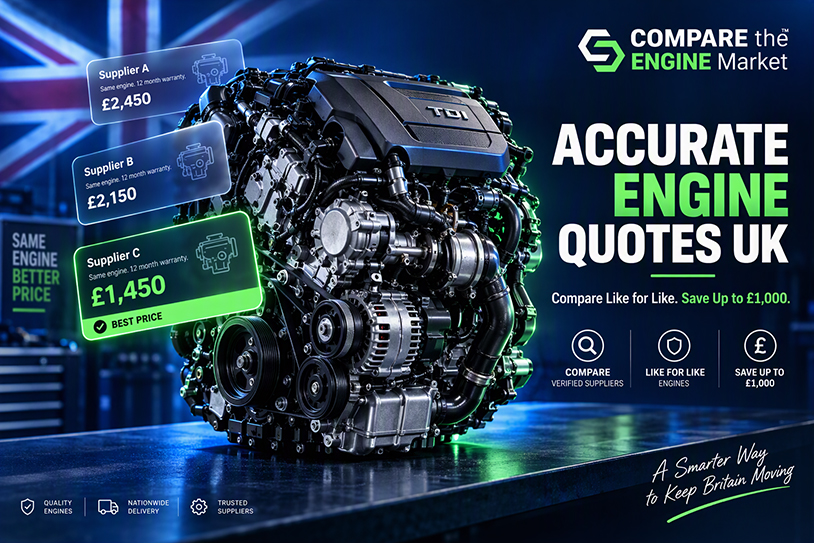
Because each supplier hears a different brief. One quotes an engine only, one quotes supply and fit, one includes a warranty and one does not. Five quotes become five different jobs, and the owner picks the cheapest number without realising it describes the smallest job. The fix is a brief that is identical for everyone, so you can compare engine quotes UK suppliers provide on a like-for-like basis.
The five-line brief
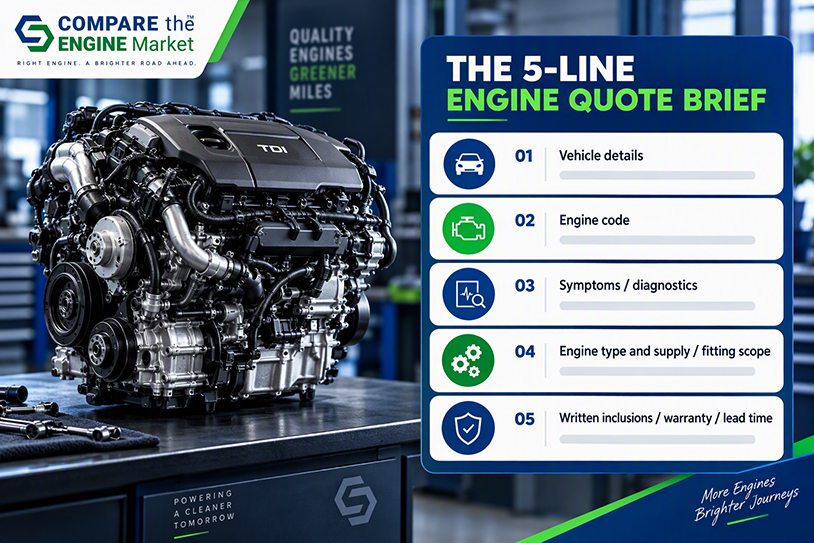
1. The vehicle: registration, make, model, year, fuel.
2. The engine code: from the REG or ask them to confirm it.
3. The symptoms: exactly what the car is doing, with any diagnostic report.
4. The scope you want: used, reconditioned or rebuilt engine; supply only or engine supply and fitting.
5. What you need to state in writing: inclusions, warranty terms, lead time.
What you should ask every supplier
- Is the code confirmed against my REG?
- Is the unit used, reconditioned or rebuilt?
- Are timing components, water pump, fluids and coding included?
- What are the warranty terms, including labour?
- What is the lead time, and when can the car be collected?
Why the brief saves money
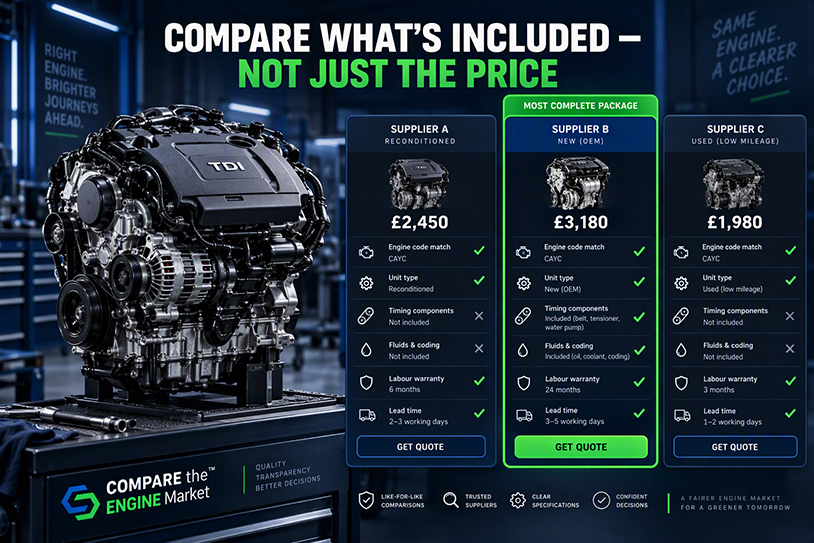
Because it converts a negotiation into a comparison. Suppliers quoting identical scope cannot hide omissions behind a lower figure, and you can see immediately which quote includes the work that matters. In practice this is where owners save £500 to £1,000 on replacement Range Rover engine costs in the UK, simply by making the quotes comparable before choosing.
What does a complete quote include?
| Item | Why it matters |
| Code confirmed | Prevents an incompatible unit |
| Unit type stated | Determines price and cover |
| Timing components | The most commonly omitted item |
| Fluids, gaskets, coding | Frequent hidden extras |
| Warranty with labour cover | Your protection if it fails |
| Lead time and date | Downtime is a real cost |
| Core exchange terms | Can reduce the price |
What should you do with the quotes when they arrive?
Put them in a table with the seven rows above and fill each cell. Within ten minutes the genuinely strongest engine replacement quote becomes obvious, and it is usually not the cheapest number at the top of the page. Then ask the two strongest suppliers a final question: what happens if the engine fails inside the engine warranty period?
How do you handle a supplier who will not provide written terms?
Walk away and keep the quote as a record of why. On engine work, a supplier who will not put terms in writing is telling you what the after-sales experience will be, and there is no shortage of suppliers who will.
Frequently asked questions
What information do I need before requesting quotes?
Registration, engine code if known, symptoms, and a clear statement of whether you need engine supply only or engine supply and fitting.
How many quotes should I get?
Three or four, all with identical scope, which is what makes them comparable.
Should I mention the cheapest quote to other suppliers?
You can, but only on identical scope. Asking a supplier to match a quote for a smaller job is a false comparison and invites a smaller job.
What if my code is unknown?
Ask each supplier to confirm it from the REG, and check that all of them agree before proceeding.
How long should a quote remain valid?
Ask. Engine quotes commonly hold for a limited period because parts and labour costs move.
What does the brief do to lead times?
It shortens them, because a supplier who knows the code, the scope and the warranty requirement can book the job immediately rather than spending a week clarifying what you want. In practice, owners who send the five-line brief get firm engine fitting lead times, and owners who ring around describing symptoms get estimates. Firm dates are what keep cars off the road for days rather than weeks.
What is the biggest mistake owners make when requesting quotes?
Asking a vague question and accepting the answer as a price. Without the code, the scope and the inclusions stated, the number you receive describes a job that may not be the job you need, and comparing it with another equally vague number tells you nothing useful about value.
How do you handle a supplier who quotes far below everyone else?
Ask what is excluded before you celebrate. On engine work, a quote well below the market almost always reflects a smaller scope rather than a better deal, and once the missing items are priced in, the figure usually returns to the middle of the range. If it does not, ask what the replacement engine warranty covers, because that is where the difference often sits.
What should you send with the brief?
Send the registration, the UK engine code if you have it, a photograph of the dashboard showing any warning lights, and any engine diagnostic report. Suppliers who receive those details can provide a more accurate engine quote the first time, and they frequently identify something the owner had not considered, which is worth more than the time it took to attach two photographs.
What is a fair response time from suppliers?
Most specialists respond within a working day, and busy ones within two. If a supplier takes a week to quote, that is a useful signal about how they handle a warranty claim, because responsiveness before the sale is generally better than responsiveness after it.
How do you keep control of the process?
Set a deadline for yourself, get the quotes in writing, compare them on identical scope, and decide on the evidence. Owners who drift from supplier to supplier for a fortnight usually end up paying more, because urgency eventually makes the decision for them and the cheapest thing available on the day is rarely the best thing available that week.
What should you do once you have chosen a supplier?
Confirm the booking in writing, agree the collection date, ask for the warranty certificate and the invoice to be prepared on collection, and keep everything in one folder. Engine jobs that go well are almost always the ones where the customer knew exactly what they were buying and had the paperwork to prove it.
What is the one-line answer on getting accurate quotes?
Send every supplier the same five-line brief, and compare inclusions rather than totals; that single habit saves most owners several hundred pounds.
What should the brief include that owners usually forget?
The engine code, the mileage, any diagnostic report and a statement of how long you intend to keep the car. The last item is the one that most changes a supplier's recommendation, because it determines whether they should be steering you towards a used unit or a reconditioned one, and a supplier who knows your plans quotes accordingly.
What does a good supplier do differently?
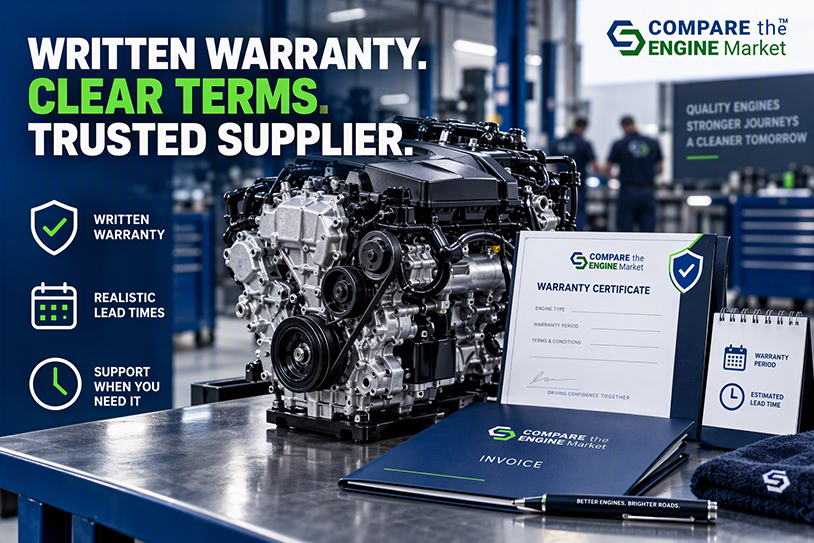
They ask about your ownership plans before recommending a route, confirm the code, state the inclusions and exclusions plainly, give a firm lead time and hand over the invoice with a warranty certificate on collection. That sequence is the signature of a trusted engine supplier in the UK, and it is worth more than a small saving.
What should you do if a supplier will not quote in writing?
Move on. A written quote costs a professional supplier two minutes and protects both parties. A refusal tells you how a warranty conversation would go in twelve months' time, when you need them to be responsive rather than reluctant.
What is the single habit that saves the most money?
Sending the same brief to everyone and comparing inclusions rather than totals. It costs nothing, it takes twenty minutes, and it removes the two things that cost engine buyers the most: incomparable replacement Range Rover engine quotes and hidden exclusions.
Written by Daniel Collins | Dedicated ET Automotive Writer & Mechanic