Is Your Citroen Relay Engine Swap Going to Cost You More Than You Think?

August 31, 2026
How to Navigate the Citroen Relay Engine Market Without Getting Caught Out by DVLA Rules
If you're considering a replacement engine for your Citroen Relay, the legal paperwork can be just as daunting as the mechanical work. Here's what you actually need to know before you start.
What the New DVLA Rules Mean for Your Citroen Relay Engine Replacement
The Driver and Vehicle Licensing Agency introduced significant changes to vehicle registration policies in 2025, and they affect how you handle a used Citroen Relay engine replacement. The workshop-floor truth rarely shared with customers is that these revisions make life easier for most owners.
Under the old rules, you'd have to notify the DVLA of virtually any substantial repair or modification. But here's the thing—like-for-like repairs and restorations no longer require notification, provided the vehicle looks exactly as it did when first manufactured and the logbook (V5C) stays unchanged. So if you're fitting a direct replacement engine of the same type, you're in the clear.
But there's a catch. Vehicles that have undergone "substantial structural changes" can keep their original REG and registration number, but you must tell the DVLA about these alterations. And if you're converting your Relay to Electrics, you can retain the original identity, but again, the DVLA needs to be informed.
One thing your last garage probably didn't mention is that an engine swap isn't just about bolting in a new unit. The UK operates a points system for vehicle identity. Major components like the engine, transmission, and bodyshell each carry a points value. If your Relay retains more than 8 points, it's legally the same vehicle. Drop below that threshold, and you're looking at re-registering it as a radically altered vehicle—a process that involves a full safety inspection.
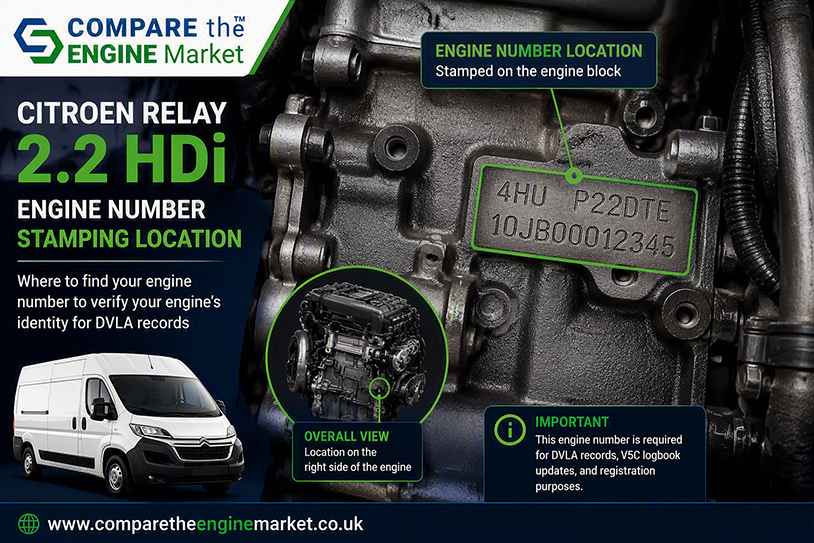
Where to Find Your Citroen Relay Engine Number When the DVLA Comes Calling
Right, so you've got the V5C logbook in front of you, and you're staring at the engine number field wondering where on earth to find it in the van. Honest answer? It's not always obvious.
The engine number location varies across the Relay range. On earlier 2.5-litre diesel models (DJ5 and DK5 engines), it's stamped on the front of the crankcase—a flat raised section near halfway up, slightly towards the gearbox side. The frustrating bit? It's almost certainly going to be hard to read unless you strip most of the front of the engine and clean it up with every cloth.
For the 3.0-litre unit, owners have reported it's not obviously on the front at all. One savvy approach is to use the REG number. If the engine is original, the REG can be used in the Citroen parts diagrams to get the engine number. Register on the service, Citroen site as a professional (non-emergency services) and as a member of the Citroen Owners Club. Once on the site, pop the REG in the top left to find your vehicle, and look under "Characteristics”.
A detail most workshops hope you never ask about is that a Citroen dealer can also help—if you provide the REG, they can supply the original engine serial number, provided it's still the original unit. And don't forget: if you have a previous V5C document, the engine serial number is already on it. Look for the pop-riveted plate under the bonnette to show the REG, axle weight limits, and engine information at the bottom.
Engine Market Comparison UK: Real Prices for Citroen Relay Replacement Units
When it comes to sourcing a replacement, the compare to the Citroen engine market UK landscape for the Citroen Relay is surprisingly varied. Using an engine market comparison UK tool helps you see the full range of options without getting stuck with the first quote you receive.
Replacement Engine Options for Citroen Relay
| Option | Price Range | Warranty | Best For |
|---|---|---|---|
| Used Engine (2.0 HDi RHV) | £450 | 3-6 months | Cost-conscious owners needing a quick fix |
| Used Engine (2.2 HDi 4HY) | £370 | 3-6 months | Budget repairs with minimal downtime |
| Reconditioned 2.2 HDi (4HV) | £1,549 | 12 months | Commercial operators needing reliability |
| Reconditioned 2.0 HDi (RHV) | £1,695 | 12 months | Owners who want peace of mind without a new price tag |
| Reconditioned 2.2 HDi (4HH) | £2,201 | 12 months | High-mileage users wanting maximum durability |
The engine cost comparison tells an interesting story. While a used 2.2 HDi (code 4HY) might set you back just £370, a reconditioned unit of the same displacement (code 4HV) costs £1,549. The difference reflects the work involved reconditioned engine has been stripped, inspected, and rebuilt with new wear parts. It's not just about the engine itself; most suppliers in the panel offer supply-and-fit services, adding £400-£700 to the total bill.
Behind the estimate, here's what actually drives the cost. The DW10 and DW12 engine families in the Relay have known issues with timing belt failure and DPF problems. A proper reconditioning addresses these common failure points using service bulletin-compliant parts. Without that work, you're just buying someone else's future problems.
Compare Engine Prices Now — See Every Option
The DVLA Points System: What Happens When You Change Your Citroen Relay Engine
Here's something most conveniently leave out. The points system isn't just an abstract concept—it has real consequences for your Relay.
The system works like this:
- Chassis or bodyshell (original or new): 5 points
- Suspension: 2 points
- Axles: 2 points
- Transmission: 2 points
- Steering assembly: 2 points
- Engine: 1 point
If your modified vehicle scores 8 or more points, it keeps its original registration number. Drop below 8, and it has to be re-registered as a "radically altered vehicle" with a Q plate. For a typical Citroen Relay engine swap, you'd still have the chassis (5 points), suspension (2 points), axles (2 points), steering (2 points), and transmission (2 points)—that's 13 points without even counting the engine. So, a like-for-like engine swap keeps you well above the threshold.
But here's where it gets tricky. If you're swapping the engine for a different type—say, fitting a 2.8-litre Iveco engine instead of the original 2.2 HDi—you might need the matching ECU. If you then swap the ECU, you may need the BSI unit and keys to match the immobiliser system, and potentially the radio. The points can add up quickly if you start changing multiple components.
The emission standards issue is another one workshops hope you never ask about. When you change the engine, your Relay must meet emission standards based on either the date of first registration or the manufacture date of the replacement engine—whichever is earlier. That's right. If you fit a newer engine that meets Euro 5 standards, but your van was first registered in 2004, you still only need to meet Euro 4 limits. But if you fit an older engine, you must meet the older standards. It's a detail that catches many owners out.
Citroen Relay Engine Interchangeability: Which Engines Actually Fit?
Looking for info on interchangability of Relay engines? One owner with a 2005 2.2 HDi asked exactly that—could they fit a 2.8 instead? The honest answer most mechanics will only give if you ask directly is that it's rarely that simple.
For alternative engines, the parts diagrams show which components are common across different engines and which other parts you might need. The 2.2 HDi comes in two variants—adjustable camshaft and non-adjustable camshaft. They're technically interchangeable, but they use different cambelts, which you'd be changing anyway.
Here's the real gotcha. Even if the engine physically fits, you'll likely need the matching ECU. Injectors on these engines are coded by the ECU, so you'd need someone with "canclip" to program them. The pumps are individually matched to the ECU too.
If you are fitting a different engine—say 2.8 instead of 2.2—you will need the ecu. And if you swap the ECU, you might need the BSI unit, keys for the immobiliser, and the radio to match.
The practical advice from an experienced owner: go for exactly the same engine code. If possible, swap the injectors and the fuel pump from your old engine onto the replacement—that way, no reprogramming is necessary. The engine codes for the 2.2 HDi are 4HY (DW12 UTED) at 77Kw, while the 2.8 is code 8140.43S at 93Kw. The gearbox might not even match up, and if it did, it might not be man enough for the extra power.
Real-World Case Study: The £1,200 DVLA Headache
One of our customers brought their 2017 Citroen Relay to us after a catastrophic timing belt failure. The engine was toast. They'd sourced a replacement of 2.0 HDi from a breakers for £450 and asked us to fit it. But here's where it got complicated.
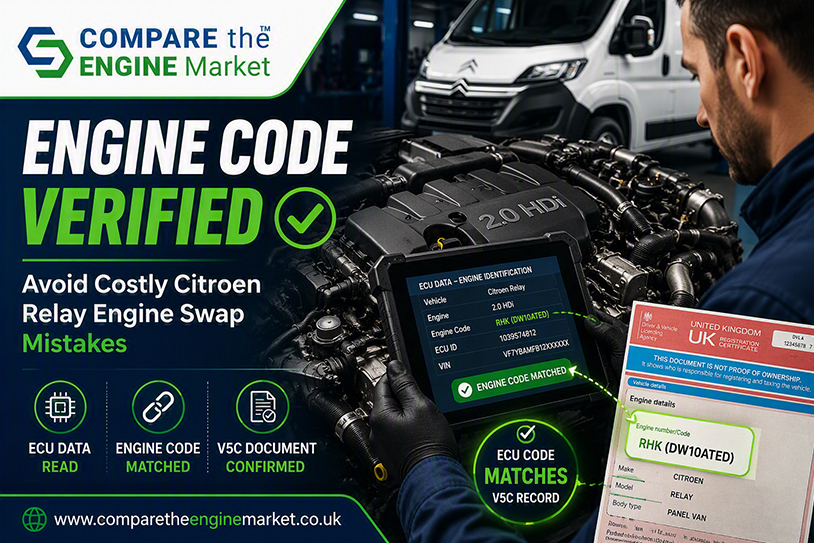
The replacement engine came without the original ECU or injectors. Three garages were quoted at between £1,800 and £2,200 for a full supply-and-fit. Our diagnostic found the engine’s injector codes used didn't match the van's ECU, meaning the immobiliser system wouldn't recognise the new unit. We sourced a matching set of coded injectors and reprogrammed the ECU to match. Total cost: £950 for the engine, injectors, coding, and fitting. The customer saved at least £850 compared to a full reconditioned supply-and-fit, but the paperwork took three weeks to sort with the DVLA because the engine number stamped on the block was partially illegible. We had to arrange for a Citroen dealer to confirm the original engine number using the REG. The customer learned the hard way that checking the engine number before purchase is absolutely critical.
Explore More About Citroen Van Engines
- Reconditioned Citroen Relay Engine Installation: How Many Hours Does It Take?
- Rebuilt Citroen Relay Engine: The Cost-Effective Alternative to Replacement
- How to Diagnose A Failing Citroen Berlingo Engine: Replacement Signs Explained
Frequently Asked Questions
Q: Do I need to tell the DVLA if I replace my Citroen Relay engine with the same type?
No. Under the new DVLA rules introduced in 2025, like-for-like repairs and restorations no longer require notification to the DVLA, if the vehicle's appearance is unchanged and the V5C logbook stays the same. However, you should keep records of the work for your own reference.
Q: What happens if I fit a different Citroen Relay engine type to my van?
If you're fitting a different engine code—for example, replacing a 2.2 HDi with a 2.8-litre unit—you must notify the DVLA of the change. The vehicle may need to meet different emissions standards, and you might need a matching ECU, injectors, and potentially a new BSI unit and keys to work with the immobiliser system.
Q: How do I find the engine number on my Citroen Relay?
The engine number location varies. On early 2.5-litre diesel models, it's stamped on the front of the crankcase—a flat raised section near the gearbox side. For newer models, look for the pop-riveted plate under the bonnet which shows the REG and engine information. You can also use the REG on Citroen's service website to retrieve the original engine number.
Q: Can a Citroen Relay engine swap help me avoid ULEZ charges?
Potentially, but it's not straightforward. A van registered before 2015 with a Euro 5 engine will still be subject to ULEZ charges in London. Swapping to a Euro 6 engine might help, but the vehicle must meet the ULEZ emissions standards based on either the first registration date or the replacement engine's manufacture date—whichever is earlier. The compare engine market UK can help you find compliant units.
Q: Is it cheaper to buy a used Citroen Relay engine or have it reconditioned?
A used engine is cheaper upfront prices for a used 2.0 HDi starts around £450. However, a reconditioned engine costs £1,500-£2,200 but comes with a 12-month warranty and has been fully inspected and rebuilt to address common failures like timing belt issues. Use a UK engine marketplace to compare both options.
Q: What's the best way to compare Citroen Relay engine prices in the UK?
Use a compare engine market UK platform like Compare the Engine Market. Enter your registration number to get quotes from multiple verified suppliers, compare prices, and check warranty terms. All reconditioned engines come with a warranty for peace of mind.
Q: Does the 8-point DVLA system affect my Citroen Relay engine replacement?
The engine comparison tool UK can help you check this. A like-for-like engine swap doesn't trigger the points threshold because you retain the chassis, suspension, axles, and transmission—typically scoring 13+ points. However, if you're swapping multiple components, you could drop below 8 points and need to re-register the vehicle. Check with the DVLA for guidance.
Bottom Line for Citroen Relay Owners
A Citroen Relay engine replacement doesn't have to be a bureaucratic nightmare. Keep your replacement like-for-like, note the engine number before you buy, and factor in the costs of ECU matching and injector coding if you're fitting a different unit. The compare engine market UK is your starting point, compare prices, check warranties, and only deal with verified suppliers. The honest answer? Getting the paperwork right saves you thousands in the long run.
Compare Engine Prices Now — See Every Option
Written by Daniel Collins | Dedicated ET Automotive Writer & Mechanic