Audi Q3 Engine Trouble: What the EA888 Oil Consumption Fault Really Costs to Fix in the UK
July 28, 2026
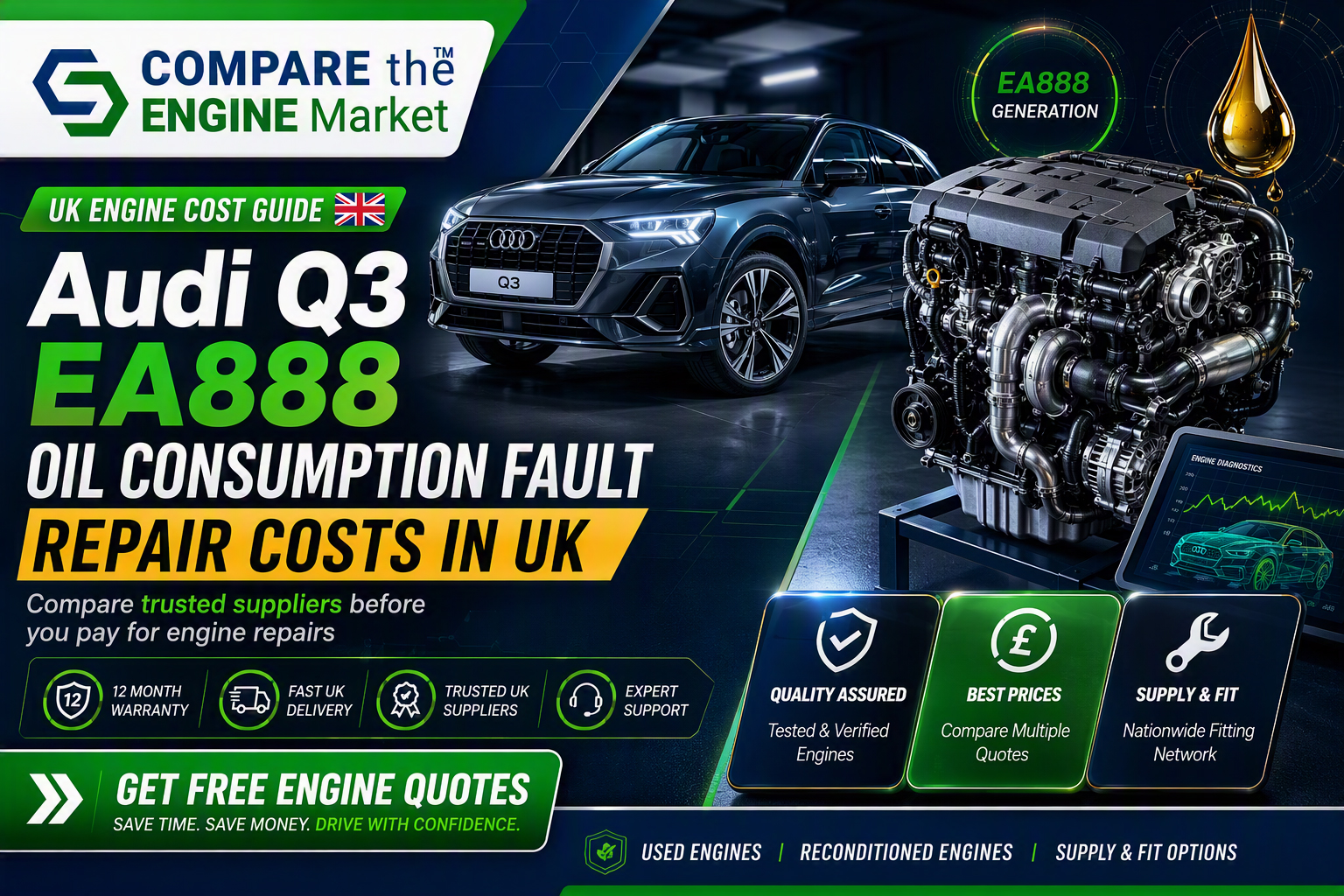
Audi Q3 EA888 Oil Consumption Fault — Repair Costs in UK
If your Audi Q3 is drinking oil between services, smoking faintly on start-up, or throwing an intermittent misfire code, you're not dealing with bad luck — you're dealing with one of the most well-documented faults in the Volkswagen Audi Group's engine history. This guide walks through what the EA888 oil consumption fault actually is, how to tell it apart from a separate dual-mass flywheel problem on diesel-automatic models, what a proper diagnosis should include before anyone quotes you for a reconditioned Audi Q3 replacement engine, and what fair UK pricing looks like across used, reconditioned, remanufactured and dealer routes in 2026.
The Fault Owners Usually Catch Too Late
If you're topping up oil between services on an early reconditioned Audi Q3 2.0 TFSI engine, you're dealing with a known design issue rather than bad luck. The early EA888 engines fitted to this generation use oil scraper rings that were undersized for the piston bore, and over tens of thousands of miles they stop controlling oil the way they should.
The practical effect: oil creeps past the rings into the combustion chamber, where it fouls spark plugs, coats the catalytic converter, and gradually starves the top end of the engine of the lubrication it needs. None of this shows up as a single dramatic warning light — it shows up as a misfire code, a slowly rising oil bill, and eventually a compression problem.
The tricky part for owners is timing. Oil consumption on this engine family tends to increase gradually rather than suddenly, which means many drivers simply get used to topping up and never connect it to a developing internal fault until a misfire appears. By that point, spark plugs are often fouled, the catalytic converter may already be partially clogged with burnt oil residue, and the repair conversation has moved from "watch it" to "fix it now."
What to Check Before You Accept a Full Engine Quote
A full block replacement isn't always the only fix, but main dealers frequently present it as the only option because ring-level repairs aren't part of their standard service menu. Before agreeing to anything, ask for these three things in writing:
1. Oil consumption rate over a measured period — a documented ml-per-1,000-miles figure, not a guess.
2. Compression test results across all four cylinders, to confirm whether bore wear has actually progressed.
3. Misfire code history — codes like P0300 (random misfire) recorded over time show whether the fault is progressing or stable.
A specialist who rebuilds EA888 units regularly can often fit updated piston and ring assemblies that correct the original design flaw, rather than replacing an otherwise sound block. This matters financially: a ring-and-piston rebuild is usually a fraction of the cost of a full-craft engine, provided the bores themselves haven't been scored by prolonged oil starvation.
It's also worth asking whether the specialist has worked on this specific engine code before, rather than EA888 in general — Audi and VW used several variants across different power outputs and production years, and the fix that works on one isn't always identical to the fix required on another.
The Separate DMF Problem on Diesel-Auto Models
Diesel Q3s paired with the DQ500 S tronic gearbox carry an unrelated wear item: the dual mass flywheel (DMF). Listen for excessive vibration at idle or a metallic rattle when the engine shuts off — both points to a DMF nearing the end of its life.
Left unaddressed, a disintegrating flywheel can send metal debris through the bell housing and, in worse cases, crack the crankcase casting. A routine clutch-and-flywheel job caught early is a different repair entirely from a powertrain rebuild caught late — the gap in cost between the two is the single best reason not to ignore the noise.
Because both the oil consumption fault and the DMF issue can produce vague symptoms. A rough-feeling used Audi engine, an occasional judder, a slightly uneven idle one, is easy for owners (and, frankly, for less experienced technicians) to conflate the two. Insist your specialist isolates which system is responsible before quoting for either repair.
The Timing Chain Question on Earlier Petrol Models
Earlier EA888 petrol variants also carried a known timing chain tensioner weakness, separate again from the oil consumption issue. A cold-start rattle lasting a couple of seconds, followed by silence once oil pressure builds, is the classic early sign — and it's worth having checked even if your main complaint is the oil top-ups, since both faults can be present on the same car.
Codes such as P0016 (crankshaft/camshaft position correlation) are a stronger signal that the chain has already stretched beyond its tolerance, rather than simply being noisy. At that point, waiting is genuinely risky. A slipped chain on this engine family can allow the pistons to contact the valves, turning a moderate repair into a catastrophic one.
What Replacement Actually Costs
Figures below reflect UK independent trade ranges observed in 2026 for the 2.0 TFSI/TDI Q3 platform. Always get a written, itemised quote rather than relying on a single headline figure.
|
Option |
Price Range |
Warranty |
Best For |
|
Used engine |
£1,200–£1,900 |
3 months |
Short-term budget fix, known low mileage |
|
Reconditioned |
£2,100–£2,900 |
6–12 months |
Balanced cost and reliability |
|
Remanufactured |
£3,000–£4,200 |
12–24 months |
Long-term keepers |
|
Main dealer crate unit |
£5,800–£7,500 |
24 months |
Cars still under factory support |
Add labour separately (typically £600–£1,200 depending on region and gearbox type), and budget £300–£450 for ancillaries — water pump, belts, and fluids — that are sensible to renew while the engine bay is already open. Ask specifically whether a core surcharge applies if your old block can't be rebuilt; £400–£700 is a common range for suppliers who quote low up front and add this later.
If you're weighing a piston-and-ring rebuild against a full unit swap, ask both suppliers for a like-for-like written comparison covering parts, labour, warranty length, and what happens if hidden damage is found once the engine is opened up. It's the only way to compare the two routes fairly rather than on headline price alone.
Red Flags Worth Walking Away From
• A quote with no compression or oil consumption figures attached — you're being asked to trust a diagnosis you can't verify.
• A supplier who can't confirm whether they're quoting the original EA888 design or an updated piston/ring specification.
• No mention of the DMF as a separate check, especially on diesel-automatic models.
• A warranty that doesn't specify whether labour is covered if the replacement fails early.
• Pressure to book same-day work before you've had a chance to get a second opinion.
Frequently Asked Questions
Is the EA888 oil consumption fault covered by any Audi goodwill scheme?
Audi has, in some cases and markets, offered goodwill contributions on documented oil consumption claims — but this varies by car age, service history, and dealer discretion, and there's no guaranteed entitlement. It's worth raising directly with a rebuilt Audi Q3 engine dealer, with your full-service history to hand, before paying for a full rebuild independently, even if the car is outside its original warranty period.
Can the oil rings be replaced without a full engine swap?
Yes, provided the block and bores haven't suffered secondary damage from prolonged oil starvation. A specialist rebuilding replacing the piston and ring assembly is usually far cheaper than a full engine replacement — this is worth exploring before accepting a dealer's swap recommendation, and the reason getting an independent second opinion before committing to a full engine quote is genuinely worthwhile.
How do I know if my Q3's noise is DMF or something else?
A DMF fault tends to show as vibration at idle that reduces once you're moving, plus a rattle specifically on shutdown. Chain or valvetrain noise, by contrast, is usually loudest on a cold start and fades as oil pressure builds. If you're unsure, ask a specialist to isolate it with a stethoscope test before quoting either repair, rather than guessing from the symptom alone.
Does fitting a non-dealer engine affect my remaining manufacturer warranty?
Under the UK's Block Exemption Regulation guidance from the Competition and Markets Authority, using an independent specialist with OEM-spec parts shouldn't void warranty on unrelated components — but keep full documentation and invoices in case this is ever queried by Audi or a future buyer.
What's the realistic downtime for an EA888 rebuild versus a full swap?
A ring/piston rebuild typically takes longer in labour hours than a straight engine swap, since it involves more precision machining and reassembly — expect 3–5 working days against roughly 2 days for a straightforward swap. Confirm this with your chosen specialist before booking the car in and ask for a courtesy car if the timeline matters to you.
Will the oil consumption issue come back after a rebuild?
Not if the rings and pistons were replaced with an updated specification designed to correct the original clearance issue. If a specialist simply refits the same original-design components, there's a real risk of the same problem recurring within a similar mileage window — always ask specifically what parts are being used.
Should I get a second opinion before agreeing to a dealer's full-engine recommendation?
Yes, especially on this platform, where the fault is well known enough that most independent VAG specialists will recognise it immediately. Secondly, itemised quote costs little and can save you thousands if a rebuild is a genuine option for your car.
Bottom Line
The EA888 oil consumption issue is a known design flaw, not a sign your Audi Q3 has been mistreated — and it doesn't automatically mean a full engine replacement. Get the fault properly measured and quoted before accepting the most expensive fix on offer, treat any DMF vibration as a separate, cheaper problem worth catching early, and always get compression and oil consumption figures in writing before you commit to any repair route.
Get a written, itemised quote from an independent VAG specialist — separating diagnosis, parts, labour and warranty — before approving any engine work.
Editorial note: cost figures reflect UK independent trade ranges observed in 2026 and will vary by supplier, region and vehicle condition. Confirm current pricing directly before budgeting.
Written by Daniel Collins | Dedicated ET Automotive Writer & Mechanic