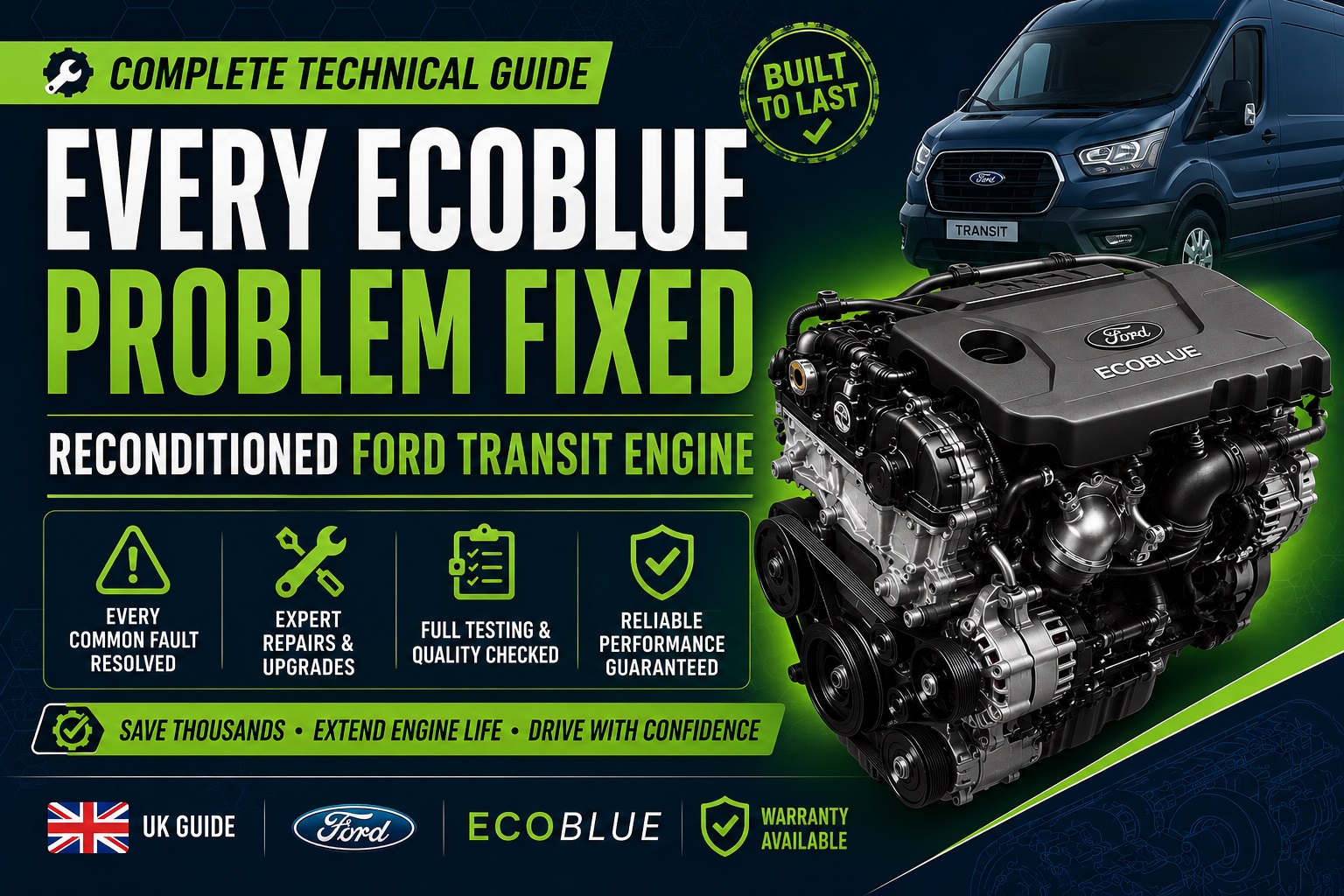
Reconditioned Ford Transit EcoBlue Engine Complete Technical Guide UK — Every Problem, Every Fix
June 1, 2026
Reconditioned Ford Transit EcoBlue Engine: The Ultimate UK Technical & Fix Guide
Quick Answer Box
What is the 2.0 EcoBlue and what is it known for? The 2.0 EcoBlue (engine codes such as YLF6 comes in ford Transit Van or YMF6 and YNF6 and variants like BLFA) is Ford’s 2.0-litre inline-4 turbo diesel introduced in 2016 for the Transit and Transit Custom. It delivers 105–170+ PS (approximately 104–168 bhp) and 360–385+ Nm torque depending on tune, in Euro 6 configurations. It is known for strong low-end torque and efficiency gains over the older Duratorq, but also for the notorious wet timing belt that runs in engine oil and can degrade prematurely, leading to debris and potential catastrophic failure if not monitored.
Power Opening
Most UK Transit owners have no idea that the 2.0 EcoBlue’s innovative “wet belt” timing system — designed for quieter running and better emissions — can start shedding rubber into the oil as early as 60,000–80,000 miles in high-duty cycles. This specific design choice has left many van drivers facing surprise engine failures that a traditional dry belt or chain would have avoided.
In this complete technical guide, you’ll discover exactly how the 2.0 EcoBlue is engineered, why it behaves the way it does under UK stop-start delivery work, and the precise fixes that keep these engines running reliably for hundreds of thousands of miles. Whether you’re a fleet operator in London or a self-employed tradesperson anywhere in the UK, you’ll leave knowing when to buy a reconditioned 2.0 EcoBlue engine and how to protect it.
Executive Summary
The 2.0 EcoBlue replaced the 2.2 TDCi Duratorq units in the Mk8 Ford Transit engine from 2016 onwards. It powers front-wheel-drive and rear-wheel-drive Transits and Customs with a focus on lower emissions, better fuel economy, and refined operation through advanced piezo injection and selective catalytic reduction (AdBlue).
Key design philosophy: compact cast-iron block with aluminium head, chain-driven auxiliaries but oil-lubricated (wet) timing belt. It is a capable, torquey workhorse — but like any modern diesel, it demands strict maintenance. Disclaimer: This guide is for informational purposes. Always verify your exact engine code (stamped on the block or visible via OBD) and consult a qualified mechanic for your specific vehicle.
SPEC SUMMARY — 2.0 EcoBlue UK (2016–present) Displacement: 2.0 litres / 1,995 cc Power output: approximately 105–170 bhp (variant dependent) Torque: approximately 360–385 Nm Configuration: inline-4-cylinder ULEZ / Euro standard: Euro 6 (AdBlue SCR) Reconditioned engine price UK: approximately £2,200–£4,000 supply and fit (depending on FWD/RWD and spec)
What Exactly Is the 2.0 EcoBlue? Full UK Technical Overview
The 2.0 EcoBlue entered production in 2016 as Ford’s new-generation diesel for commercial vehicles. It powers the Transit Custom, full-size Transit (FWD and RWD configurations), and related models like the Ranger in some markets. Variants include 105 PS, 130 PS, and 170 PS outputs.
It replaced the long-running 2.2 TDCi and was itself updated for Euro 6.2 compliance with improved aftertreatment. Later mild-hybrid versions appeared, but the core diesel remains the workhorse. What replaced it? Incremental updates and electrification paths, but the base 2.0 EcoBlue architecture continues in current models.
What Are the Key Specs of the 2.0 EcoBlue? Displacement, Power and Torque Explained
The 2.0 EcoBlue uses an 84 mm bore × 90 mm stroke for 1,995 cc displacement. It features a cast-iron block for durability under load and an aluminium head for weight savings and heat dissipation. High-pressure common-rail piezo injectors (8-hole) deliver precise fuel metering, paired with variable-geometry turbocharging.
|
Variant |
Displacement |
Power |
Torque |
Years |
|
Entry (e.g. YL) |
1,995 cc |
105 PS |
~360 Nm |
2016– |
|
Mid (e.g. YM) |
1,995 cc |
130 PS |
~385 Nm |
2016– |
|
High (e.g. YN) |
1,995 cc |
170 PS |
~360–420 Nm |
2016– |
Power and torque curves are tuned for strong delivery from low RPM, ideal for laden vans.
How Is the 2.0 EcoBlue Built? Internal Architecture Explained
Ford engineered the 2.0 EcoBlue with a high-strength cast-iron block and aluminium cylinder head. It uses a DOHC 16-valve layout with a wet timing belt running in engine oil for reduced friction and noise. Fuel delivery is high-pressure direct injection with piezo injectors. Turbo configuration is single variable-geometry on most UK Transits (biturbo on higher-performance applications). Cooling is robust with an efficient system to handle sustained loads.
Timing System — Why It Matters and What to Watch
The wet belt is a key engineering decision for efficiency and refinement. However, it operates in the oil bath, making it sensitive to oil quality, change intervals, and contamination from incomplete DPF regens.
Fuel System — Injection Type and Common Wear Points
Piezo injectors provide excellent atomisation but can suffer from clogging if poor fuel or neglected filters are used. The high-pressure pump is another wear item under heavy use.
Where Does the 2.0 EcoBlue Fail? Engineering Analysis of UK Root Causes
The 2.0 EcoBlue is generally robust, but specific design choices create known vulnerabilities in UK operating conditions (short runs, high idling, variable loads).
Failure Point 1 — Wet Timing Belt Degradation: engineering reason this is weak
The oil-lubricated belt degrades faster than expected in real-world use due to fuel dilution from DPF regens and heat cycling. Symptoms appear from approximately 60,000–100,000 miles. Repair cost if caught early: approximately £1,500–£2,500; full engine damage: approximately £4,000–£8,000+. Preventable with strict 5,000–8,000-mile oil changes using Ford-spec WSS-M2C950-A oil.
Ignoring this known weakness costs approximately £5,000+ in downtime and repairs. Don’t wait for the low oil pressure light.
Failure Point 2 — EGR Valve and Cooler Issues
Exhaust gas recirculation components clog with carbon in urban/stop-start use. Root cause: high EGR rates for emissions. Mileage: 80,000+. Cost: approximately £800–£1,800. Regular cleaning helps.
Failure Point 3 — Injector and Turbo Wear
Piezo injectors and turbos suffer from contaminated oil or poor maintenance. Root cause: sensitivity of modern high-pressure systems. Mileage: 100,000+. Cost: approximately £1,200–£3,000. Use quality fuel and filters.
What Makes the 2.0 EcoBlue Different from Its Predecessor / Rival?
The main predecessor was the 2.2 TDCi Duratorq.
|
Spec |
2.0 EcoBlue |
2.2 TDCi Duratorq |
Verdict |
|
Displacement |
1,995 cc |
2,198 cc |
Similar capacity, lighter |
|
Timing |
Wet belt |
Chain (more durable) |
EcoBlue quieter but higher risk |
|
Emissions |
Euro 6 + AdBlue |
Earlier Euro standards |
Superior compliance |
|
Efficiency |
Better |
Good |
EcoBlue wins on fuel economy |
|
Low-end torque |
Strong |
Very strong |
Comparable for van work |
Decisive technical verdict: The 2.0 EcoBlue offers refinement and emissions advantages but trades some long-term mechanical simplicity for the wet belt. For high-mileage reliability, many prefer a well-maintained reconditioned 2.0 EcoBlue with updated components over older chains if ULEZ compliance is required.
Is the 2.0 EcoBlue ULEZ Compliant? UK Emissions Standards Explained
Yes — all 2.0 EcoBlue engines meet Euro 6 standards with AdBlue SCR, making them ULEZ and CAZ compliant across the UK. Proper AdBlue use and DPF maintenance are essential. Long-term outlook is positive with retrofit options limited but software updates available. Non-compliant older engines may need replacement with a reconditioned Euro 6 unit.
What Maintenance Does the 2.0 EcoBlue Need to Reach Full Life?
Follow Ford schedules strictly: oil and filter change every 5,000–10,000 miles (use exact Ford-Castrol Magnatec WSS-M2C950-A 5W-30). Wet belt inspection/replacement around 80,000–120,000 miles or sooner in severe use. Monitor for oil dilution, change fuel filters regularly, and service the EGR/DPF system. Critical items: quality AdBlue, clean air filter, and coolant checks. With diligent care, 200,000+ miles are realistic.
FAQs — 2.0 EcoBlue Technical Questions UK
What is engine code 2.0 EcoBlue?
It refers to Ford’s 1,995 cc turbo diesel family (codes like YNF6, YMFA, BLFA etc.) used in Transits from 2016.
What vehicles use the 2.0 EcoBlue?
Primarily Ford Transit, Transit Custom (FWD/RWD), and some Rangers/Tourneos.
Is YNF6 the same as YNFA?
They are closely related variants with minor calibration or emissions differences; confirm exact fitment.
How do I find the engine code on my car?
Check the stamping on the block (near oil filter or front), VIN, or use OBD diagnostic tools.
What is a reconditioned 2.0 EcoBlue engine price?
Approximately £2,200–£4,000 supply and fit in the UK, often with warranty.
How reliable is the wet belt?
It requires proactive maintenance; many fail earlier than the claimed 150,000 miles without strict servicing.
Can I swap a 2.0 EcoBlue into an older Transit?
Possible but involves significant wiring, emissions, and mounting work — engine swap cost UK is high.
Explore More: Ford Engine Related Technical Guides
Rebuilt Ford Transit 2.0 EcoBlue Engine: Find Replacement Options and Cost Comparison
Maximize Your Ford Transit with a 2.0 EcoBlue Engine Upgrade: A Comprehensive Guide
Ford Transit Engine Fitting Cost UK: What to Expect and How to Save Money
The Average Lifespan of A Reconditioned Ford Tourneo Engine: Expectations and Reality
Looking for a Reconditioned 2.0 EcoBlue? Compare Vetted UK Supplier Prices
Buying a reconditioned 2.0 EcoBlue engine from a trusted UK specialist gives you peace of mind with proper machining, OEM-spec parts, and meaningful warranties. Many suppliers offer supply-and-fit packages with risk reversal — if it doesn’t fit or perform, they’ll sort it. Compare quotes today to avoid downtime. A quality reconditioned unit often outperforms a tired original while saving thousands versus a new Ford Transit engine. Contact vetted suppliers for your exact chassis and power variant.
Written by Daniel Collins | Dedicated ET Automotive Writer & Mechanic